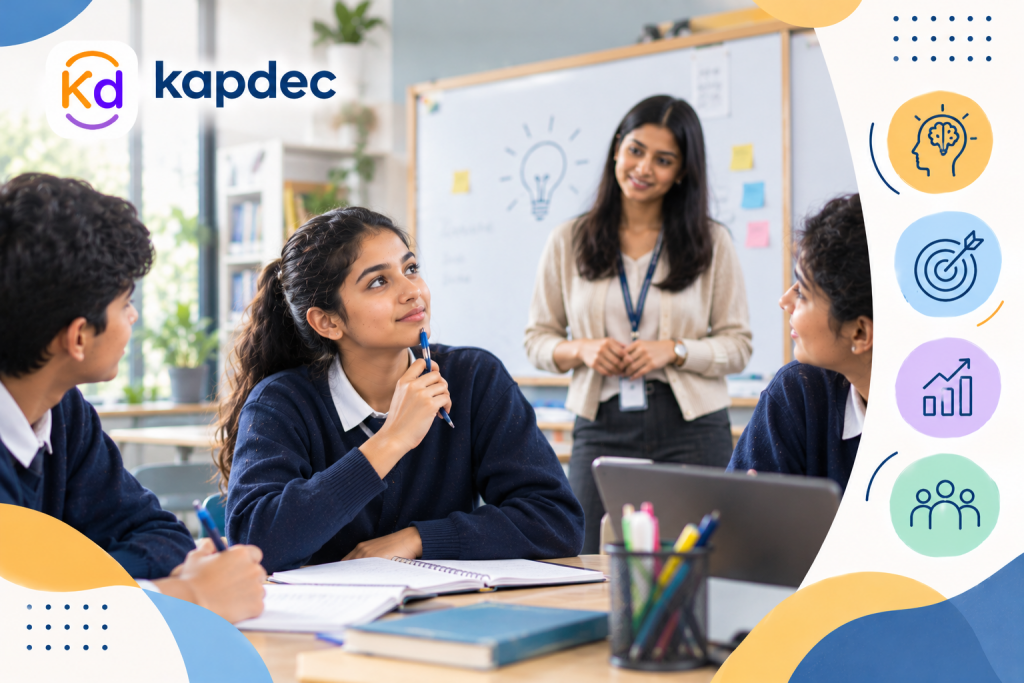
Discover how predicting the answer before learning helps students question assumptions, investigate mistakes, and build deeper conceptual understanding.
Predicting the Answer Before Learning: A Better Way to Teach
Predicting the Answer Before Learning can transform a classroom from a place where students simply receive information into an environment where they actively question, investigate, and discover. Instead of introducing a concept and immediately explaining the correct answer, teachers can begin with a simple question: What do you think will happen, and why?
This small change encourages students to think independently before they are given an explanation. They must draw on their existing knowledge, identify what they believe to be true, and explain the reasoning behind their assumptions. Even when their predictions are incorrect, the process creates valuable opportunities for learning.
In traditional classrooms, students often focus on remembering the correct answers. Prediction-based learning shifts the focus towards understanding why an answer makes sense, how evidence supports it, and when an initial assumption needs to change.
Why Predicting the Answer Before Learning Matters
Students frequently enter a lesson with existing ideas about how the world works. Some are scientifically accurate, while others may be incomplete or mistaken. If teachers explain the correct concept immediately, students might memorize the information without recognizing the gaps in their understanding.
Asking students to predict an outcome first makes those ideas visible.
For example, before teaching gravity, a teacher might ask whether a heavy object falls faster than a lighter object when both are dropped from the same height. Students can record their predictions and explain their reasoning before the teacher demonstrates the outcome.
The discussion becomes more meaningful because students now have a question they genuinely want to resolve.
This approach supports three important learning habits:
- Curiosity: Students become interested in discovering whether their predictions are correct.
- Critical thinking: They must explain the reasoning behind their answers.
- Reflection: They learn to reconsider their assumptions when new evidence challenges them.
Rather than treating learning as the simple delivery of information, teachers create opportunities for students to participate in building their own understanding.
1. Encourage Students to Predict Before Introducing a Lesson
Prediction works best when students have an opportunity to think independently before hearing the teacher’s explanation or their classmates’ answers.
Teachers can begin with a practical problem, an unusual observation, a diagram, or a question connected to the upcoming topic. Students can write down their predictions, discuss them in pairs, or choose from several possible outcomes.
For example, in a mathematics class, a teacher might ask students what happens to the area of a rectangle when its length doubles but its width remains unchanged. In a literature lesson, students could predict a character’s next decision based on earlier events. In science, they might predict how a plant will respond to different amounts of sunlight.
The goal is not to test students before they have learned the material. It is to activate their existing knowledge and give them a reason to investigate.
Teachers should also ask students to explain why they made a particular prediction. Two students may reach the same conclusion using completely different reasoning, creating opportunities to explore how they think.
When students understand that their initial answers are starting points rather than final judgments, they become more willing to participate.
2. Turn Incorrect Predictions Into Learning Opportunities
One of the most valuable aspects of prediction-based learning is that an incorrect answer can become the beginning of deeper understanding.
Students sometimes avoid answering questions because they fear embarrassment or losing marks. However, when a classroom treats mistakes as opportunities to investigate, students can participate without feeling that every response must be perfect.
Suppose a student predicts that a larger object will always sink in water while a smaller object will float. Instead of immediately correcting the student, the teacher can demonstrate how differently shaped objects behave in water and ask the class to explain the results.
Students can compare their original predictions with what they observe, identify the assumptions behind their answers, and develop a more accurate explanation.
This process teaches an important lesson: being wrong is not the same as failing to learn.
Teachers can encourage this mindset by asking questions such as:
- What made you choose this answer?
- Which part of your prediction was correct?
- What evidence surprised you?
- How would you change your explanation now?
These questions move the discussion away from simply identifying mistakes and towards understanding how thinking develops.
3. Help Students Compare Their Assumptions With Evidence
A prediction becomes educationally powerful when students have an opportunity to test it against reliable evidence.
After students record their initial answers, teachers can introduce an experiment, worked example, demonstration, reading passage, dataset, or real-world observation. Students then compare what they expected with what actually happened.
For example, students studying probability might predict the outcome of rolling a die several times. After conducting the experiment, they can compare their expectations with the observed results and discuss why a small sample may not produce an even distribution.
The teacher can guide the discussion through three stages:
- Prediction: What did you expect to happen?
- Evidence: What did you observe or discover?
- Revision: What does the evidence suggest, and would you change your original explanation?
This structured comparison helps students distinguish between what they believe and what the available evidence supports.
It also develops habits that extend beyond school. Students learn to question unsupported claims, examine information carefully, and change their conclusions when stronger evidence becomes available [1].
4. Build a Classroom Culture That Rewards Thinking
Prediction-based activities are most effective when students feel comfortable sharing different ideas. If only correct answers receive praise, students may stop taking intellectual risks as like Kapdec.
Teachers can instead recognize thoughtful reasoning, careful observations, useful questions, and the willingness to revise an explanation.
A simple classroom routine can make this possible. At the beginning of a lesson, students record a prediction. During the activity, they gather evidence. At the end, they revisit their original response and explain what they learned.
Teachers can even maintain a prediction journal where students document their assumptions and reflect on how their understanding changes over time.
The purpose is not to make every lesson complicated or time-consuming. Even a two-minute prediction question can encourage students to engage more actively with a new topic.
Over time, this routine helps establish a classroom environment where questioning is encouraged, mistakes are discussed constructively, and understanding matters more than guessing the teacher’s expected answer.
5. Make Learning More Meaningful Across Subjects
Predicting the answer before learning is not limited to science experiments. Teachers can adapt it to almost any subject.
- Mathematics: Ask students to estimate an answer before solving a problem and then compare their estimates with the calculated result.
- Science: Invite students to predict what will happen during an experiment before observing the outcome.
- English: Ask students to predict a story’s ending using clues from the text.
- History: Encourage students to predict the consequences of a historical decision before examining what happened.
- Social studies: Ask students to predict how a change in one factor might affect a community, then examine relevant evidence.
These activities connect new information with students’ existing knowledge. They also make lessons more interactive because learners have a personal question to resolve.
Teachers should choose predictions that are meaningful, testable where possible, and appropriate to students’ age and prior knowledge.
FAQ’s
What is predicting the answer before learning?
Predicting the answer before learning is a teaching strategy in which students are encouraged to guess or anticipate an outcome before a teacher explains a new concept. Students use their existing knowledge, observations, and reasoning to make predictions. Once the lesson begins, they compare their initial ideas with the information they learn. This approach encourages curiosity, active participation, and a deeper understanding of concepts rather than simply memorizing facts.
How does prediction-based learning improve critical thinking skills?
Prediction-based learning strengthens critical thinking by encouraging students to analyze information, explain their reasoning, and evaluate different possibilities. Instead of accepting information immediately, students learn to ask questions and consider why an outcome might occur. When they compare their predictions with evidence, they develop the ability to identify gaps in their understanding, recognize patterns, and make more informed conclusions. These skills are valuable in academics and real-world decision-making.
Why should teachers encourage students to make incorrect predictions?
Incorrect predictions can reveal misunderstandings and create opportunities for meaningful learning. When students discover that their predictions do not match the actual outcome, they have a reason to investigate what went wrong and reconsider their assumptions. Teachers can guide this process through discussions, experiments, and practical examples instead of simply providing the correct answer. This also helps students view mistakes as a natural part of learning, making them more confident about asking questions and participating in classroom activities.
How can teachers use prediction-based learning in different subjects?
Teachers can incorporate prediction-based learning into almost any subject by asking questions before introducing the main concept. In mathematics, students can estimate an answer before solving a problem. In science, they can predict the results of an experiment. In English, students can anticipate how a story might end using clues from the text. In history, they can consider the possible consequences of a historical decision before examining what actually happened. These activities make lessons more interactive and help students connect new information with their existing knowledge.
How can students compare their predictions with evidence?
Students can compare predictions with evidence by recording their initial answers, observing the results of an activity, and identifying similarities or differences between what they expected and what happened. Teachers can ask students to explain which assumptions were correct, what surprised them, and how the evidence changes their understanding. For example, after predicting the outcome of a science experiment, students can examine their observations and develop an evidence-based explanation. This process encourages reflection, logical reasoning, and a willingness to revise conclusions when new information becomes available.
Can predicting answers before learning improve student engagement and classroom participation?
Yes, predicting answers before learning can improve student engagement by giving learners an active role in the lesson from the beginning. When students are invited to share their ideas, they become more curious about the topic and more interested in discovering the correct explanation. This approach can also encourage quieter students to participate through written predictions, pair discussions, or small-group activities. By creating a classroom environment where different ideas are welcomed and mistakes are treated as learning opportunities, teachers can promote confidence, collaboration, and a stronger interest in learning.
Conclusion: Let Students Think Before Giving Them the Answer
Predicting the Answer Before Learning offers teachers a practical way to encourage curiosity, independent reasoning, and evidence-based thinking. By asking students to make predictions, investigate unexpected results, and reconsider their assumptions, teachers can turn ordinary lessons into opportunities for deeper understanding.
The real value lies not in whether students predict correctly the first time, but in how they respond when new information challenges their thinking.
When students learn to ask questions, test ideas, and revise their explanations, they develop skills that extend far beyond examinations. They become more thoughtful learners who understand that knowledge grows through exploration, reflection, and evidence.
Sometimes, the most effective way to begin teaching a concept is not by explaining it immediately, but by giving students a reason to discover it for themselves.