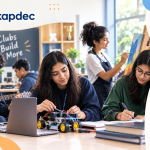
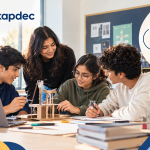
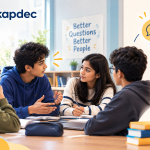
School Projects develop planning, research, collaboration, problem-solving, creativity, and execution skills that traditional exams may not fully measure.
School Projects: Why They Teach More Than School Exams
School Projects offer students something that traditional examinations cannot always provide: the opportunity to use knowledge in situations where the answer is not already defined.
Exams have an important place in education. They can measure individual understanding, subject knowledge, problem-solving ability, and how effectively students perform under specific conditions.
But real-world challenges rarely look like examination questions.
They often involve incomplete information, competing ideas, unexpected problems, deadlines, collaboration, and multiple possible solutions.
School projects introduce students to this kind of learning environment.
Instead of simply answering a question, students may need to decide what to investigate, how to approach it, what resources to use, and how to turn an idea into a finished outcome.
That makes projects an important complement to traditional academic assessment.
Why School Projects Go Beyond Knowing the Answer
An examination generally gives students a clearly defined task.
A project can begin with a much broader challenge.
A student might be asked to investigate water pollution, design a simple robot, build an application, create a business model, conduct an experiment, or develop a solution to a local problem.
Before producing an answer, the student has to determine where to begin.
This requires planning, research, judgment, and decision-making.
Students therefore discover that knowing information is only one part of solving a problem.
The more important question becomes:
How can I use what I know?
Projects Teach Students to Work With Ambiguity
Many exam questions have a predetermined answer or a clearly defined method.
Projects can be much less predictable.
A student’s first idea may fail. Research may produce unexpected information. A prototype may not work. A planned experiment may produce results that differ from expectations.
Instead of treating these outcomes simply as failure, students can learn to investigate what happened and adjust their approach.
This develops adaptability.
Students begin to understand that meaningful problem-solving often involves testing, learning, changing direction, and trying again.
This is particularly relevant to STEM fields, where experimentation and iteration are central to scientific and engineering work.
Breaking Complex Problems Into Manageable Tasks
Large projects can initially seem overwhelming.
A student may understand the final objective but not know how to reach it.
Projects teach students to divide large problems into smaller tasks.
For example, designing a basic environmental monitoring device might involve:
- Researching the environmental problem
- Identifying the required measurements
- Selecting appropriate components
- Designing the system
- Building a prototype
- Testing the device
- Analyzing the results
- Improving the design
- Presenting the final product
Each step contributes to the larger goal [1].
Students gradually learn that complex problems become more manageable when they are organized into smaller, connected challenges.
Deadlines, Feedback, and Iteration Build Practical Skills
Projects also introduce students to something that exams rarely replicate: iteration.
A student creates something, receives feedback, identifies weaknesses, makes changes, and produces an improved version.
This teaches students that the first version does not have to be perfect.
Feedback becomes information that can be used to improve the work.
Students learn to ask:
- What worked?
- What did not work?
- Why did it happen?
- What should I change?
- How can the next version be better?
These habits are valuable far beyond school.
How Group Projects Teach Accountability
Individual assignments demonstrate what one student can accomplish independently.
Group projects introduce another dimension: responsibility to other people.
Students must divide responsibilities, coordinate deadlines, communicate expectations, resolve disagreements, and make sure their contributions are completed.
They may also discover that teammates have different working styles or opinions.
These situations create opportunities to practice negotiation and compromise.
This connects closely with [Why Schools Need to Teach Students How to Handle Disagreement], because successful collaboration requires students to communicate differences without allowing disagreements to prevent progress.
Projects Connect Subjects That Classrooms Often Separate
School subjects are frequently organized into separate periods.
Real-world problems rarely respect those boundaries.
Imagine a student designing a solar-powered vehicle.
The project could involve:
- Physics — energy, motion, and forces
- Mathematics — measurements and calculations
- Computer science — programming and automation
- Engineering — design and testing
- Writing — documentation and explanation
- Art and design — presentation and appearance
Students begin to see how different areas of knowledge work together.
Instead of thinking of subjects as isolated boxes, they start seeing connections between them.
Student Choice Can Reveal Hidden Interests
Projects can also reveal interests that traditional assessments may overlook.
When students have some freedom to decide what they investigate or build, they may discover unexpected strengths.
One student might become fascinated by robotics.
Another might discover an interest in environmental science, coding, biomedical technology, data analysis, or product design.
This connects with Why High School Students Should Stop Waiting for College to Discover What They’re Good At.
Projects allow students to turn curiosity into evidence.
Instead of simply saying they are interested in a particular field, students can demonstrate that interest through something they have researched, designed, tested, or created.
How Schools Can Measure More Than the Final Product
Effective projects should not simply reward attractive presentations or impressive-looking models.
They should measure both knowledge and application.
Teachers can evaluate:
- Conceptual understanding
- Research quality
- Planning
- Problem-solving
- Creativity
- Collaboration
- Execution
- Communication
- Reflection
- Response to feedback
This provides a broader picture of student capability.
A student may not produce a perfect final product but demonstrate exceptional reasoning, persistence, and improvement throughout the process.
Those qualities can be educationally valuable in their own right.
The Role of Mentorship in Meaningful Projects
A strong mentor can make project-based learning even more effective.
Students may have interesting ideas but struggle to define the problem or decide where to begin as kapdec.
A mentor can help students ask better questions, evaluate possible approaches, identify useful resources, and reflect on setbacks without simply providing the solution.
The student remains responsible for the investigation and execution.
This balance encourages independence while giving students structured guidance.
FAQ’s
Why can school projects teach skills that exams may not measure?
School Projects require students to apply knowledge in situations that may not have a single predetermined answer. Students often need to research a topic, develop a plan, make decisions, manage deadlines, solve unexpected problems, and produce a final outcome.
Exams are useful for measuring individual understanding under specific conditions, but projects can reveal additional abilities such as planning, creativity, collaboration, communication, persistence, and execution. Together, both approaches can provide a broader picture of student learning.
How do school projects help students deal with ambiguity?
Projects often begin with an idea or broad problem rather than a clearly defined question with one correct answer. Students have to determine what information they need, which approach might work, and how to respond when their first attempt does not succeed.
This teaches students that uncertainty is a normal part of problem-solving. Instead of immediately searching for a correct answer, they learn to investigate possibilities, test ideas, evaluate results, and make adjustments. These skills are especially relevant to STEM learning and real-world challenges.
What skills do students develop when they break a large project into smaller tasks?
Large projects can teach students how to turn an overwhelming objective into a series of manageable steps. They may need to research the problem, establish priorities, create deadlines, divide responsibilities, test their ideas, and evaluate progress.
This develops planning, organization, time management, critical thinking, and problem-solving. Students also learn that complex outcomes are often achieved through many smaller decisions rather than through one dramatic solution.
Why are deadlines, feedback, and iteration important in school projects?
Projects give students opportunities to experience the process of creating, reviewing, and improving their work. Their first attempt may not be successful, but feedback can help them identify weaknesses and make meaningful changes.
This teaches students to view mistakes and criticism as information rather than simply as evidence of failure. Learning to revise work based on evidence and feedback is a valuable habit for academic research, engineering, programming, writing, and many other fields.
How do group projects teach skills that individual assignments cannot?
Group projects require students to work with people who may have different ideas, strengths, communication styles, and approaches to completing tasks. Students have to divide responsibilities, coordinate deadlines, communicate clearly, and remain accountable to their teammates.
They may also need to negotiate when team members disagree. These experiences can develop collaboration, responsibility, communication, and conflict-resolution skills that are difficult to reproduce through an individual examination.
Should school projects replace exams as the main form of assessment?
School projects do not necessarily need to replace exams. The two forms of assessment can serve different purposes.
Exams can help teachers measure individual knowledge, conceptual understanding, and the ability to apply information under defined conditions. Projects can show how students use that knowledge in more open-ended situations involving research, planning, collaboration, experimentation, and communication.
Final Thoughts
School Projects do not make examinations unnecessary.
Instead, they measure different dimensions of learning.
Exams can show what students understand and how effectively they can demonstrate that knowledge under defined conditions.
Projects can reveal how students plan, research, collaborate, experiment, adapt, communicate, and execute when faced with a less predictable challenge.
That distinction matters because the problems students encounter beyond school rarely come with four answer choices and a clearly defined method.
They have to determine what the problem is, decide where to begin, gather information, test possible solutions, learn from setbacks, and improve their approach.