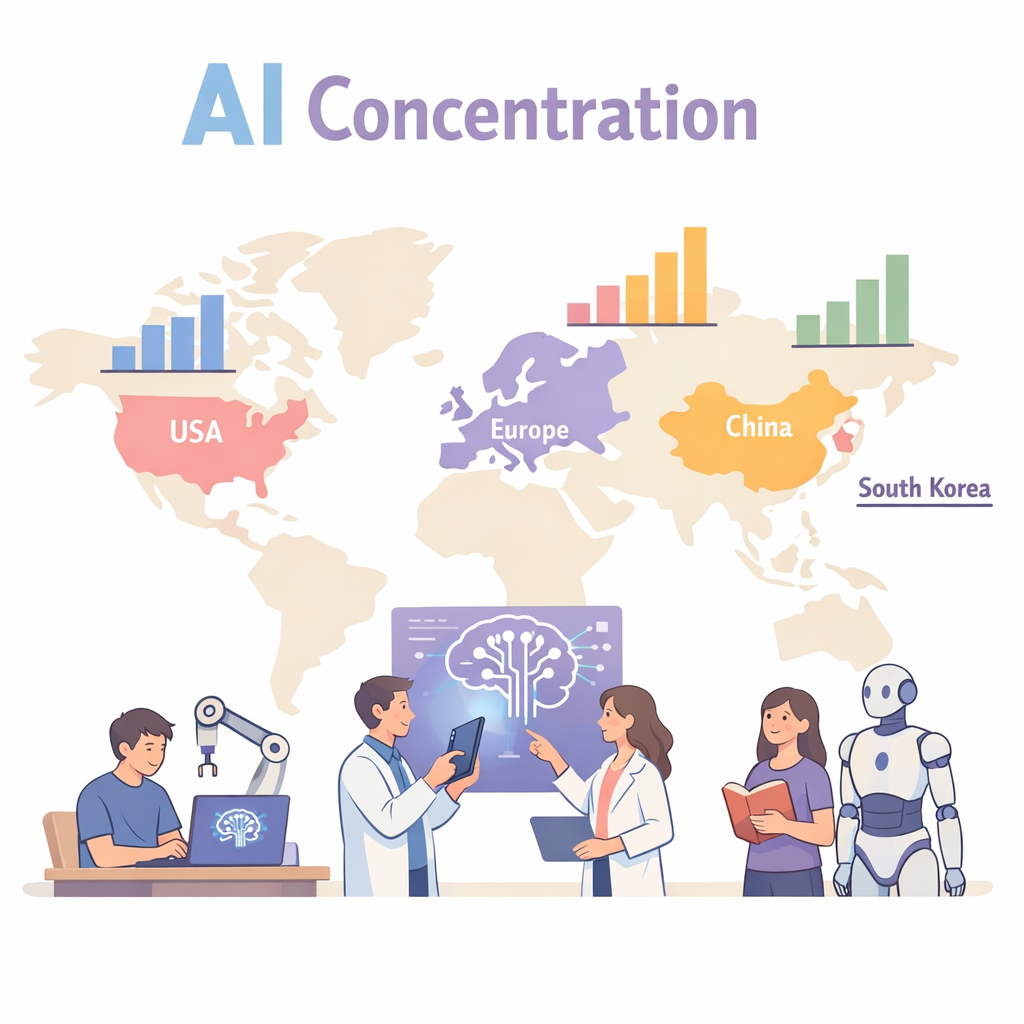
Artificial intelligence is advancing at an unprecedented pace — but are its benefits truly global, or are they quietly concentrating in just a handful of nations?
As AI reshapes economies, education, and the future of work, a growing body of research suggests that access to its advantages may depend less on ambition and more on infrastructure and language.
If AI is meant to democratize opportunity, why does its impact appear so uneven — and what do you think needs to change to make its promise more inclusive?Artificial intelligence is seeing rapid adoption across the globe, but its advantages are not evenly distributed. According to a report by Microsoft’s AI Economy Institute, the benefits of AI are primarily concentrated in a limited number of countries. The study highlights two major factors contributing to this concentration: infrastructure and language.
The availability and quality of digital infrastructure play a critical role in determining how effectively a country can harness AI technology. Nations with advanced internet connectivity, robust data storage facilities, and state-of-the-art computing resources have a significant advantage. These factors enable quicker implementation and integration of AI systems into various sectors, such as healthcare, finance, and education.
Language also emerges as a key differentiator in the report. Most current AI technology is predominantly developed in English or other widely spoken languages. This language barrier creates challenges for non-English speaking countries to fully access and benefit from AI advancements. Consequently, countries with populations that primarily speak less common languages might find it harder to integrate AI into their societies at the same pace.
The report emphasizes that despite AI’s potential to improve productivity and enhance economic growth, the uneven distribution of its benefits could exacerbate existing global inequalities. Countries that lack the necessary infrastructure or face language barriers might fall further behind in reaping the rewards of AI technology.
Addressing these imbalances is seen as a critical task for global stakeholders. Efforts to improve infrastructure and develop AI solutions in more languages could help democratize access to AI benefits. This would require collaboration among governments, tech companies, and international organizations to ensure a more equitable distribution of AI’s advantages.
In conclusion, while AI advances rapidly, its benefits remain confined to select regions due to infrastructure and language challenges. Tackling these issues could play a key role in spreading the advantages of AI more broadly, promoting global progress and reducing disparities.
Source: Campus Technology
Read Original:
https://campustechnology.com/Articles/2026/02/20/AI-Adoption-Is-Surging-but-Infrastructure-and-Language-Gaps-Persist.aspx