Kapdec Resources
Place Value System
KAPDEC® | Elite STEM Learning Platform | https://kapdec.comUnit: Number System Chapter: Place Value System Reference: – Introduction to Place Value, Face Value vs Place Value, I...
KAPDEC® | Elite STEM Learning Platform | https://kapdec.com
Unit: Number System
Chapter: Place Value System
Reference: – Introduction to Place Value, Face Value vs Place Value, Indian Place Value System (Ones, Tens, Hundreds, Thousands, Lakhs, Crores), International Place Value System (Ones, Tens, Hundreds, Thousands, Millions, Billions), Comparison of Indian and International Systems, Expanded Form, Writing Numbers in Words, Use of Commas
After studying this chapter, you should be able to understand:
- Introduction to Place Value & Its Need
- Face Value vs Place Value
- Indian Place Value System (Ones to Crores)
- International Place Value System (Ones to Billions)
- Comparison of Indian and International Systems
- Expanded Form of Numbers
- Writing Numbers in Words
- Use of Commas in Both Systems
Introduction: Place Value System, India and International
According to our number system, the value of a digitdepends upon the place it holds in the number.
The TRUE and ACTUAL value of a number depends on two factors:
- Face value of a digit in a number is the digit itself
- Place value of a digit in a number depends upon the place it occupies in the place value chart (you can also call it as the “position” of digit in a number)
In the Base-10 number system, starting from “right hand side” AND moving towards left, each place has a value of 10 times the place to its right.
- The value of the first place beginning at the “extreme” right is “one”
- The value of the next place left to it is “ten” i.e. 10 times of 1,
- The value of place left to tens place is “hundred” i.e. 10 times 10, the next is “thousand” and so on.
Examples:
(a) The face value of 9 in 19,650 is 9.
(b) The face value of 1 in 2,515 is 1.
So, the VALUE of a digit in any number
= Face Value of the Digit × Place Value of the place it occupies in the place value chart
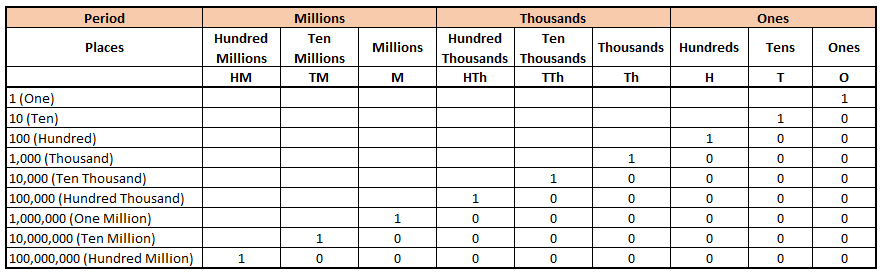
Let us understand the concept of place value through a place value chart-
Source: Kapdec.com
In the above table,
- The place value of '1' at ones place is one or '1'.
- At tens place the place value of 1 is 1 × 10 i.e. '10'
- At hundreds place the place value of 1 is 10 × 10 i.e. '100'
- At thousands place the place value of 1 is 100 × 10 i.e. '1,000'
- At ten-thousands place the place value of 1 is 1,000 × 10 i.e. '10,000'
- At hundred-thousand place the place value of 1 is 10,000 × 10 i.e. '100,000'
- At one-million place the place value of 1 is 100,000 × 10 i.e. '1,000,000'
Examples:
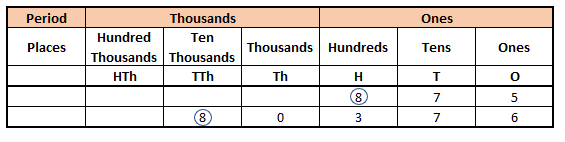
What is the place value and face value of "8" in
- 875
- 80,376
Let us have a look at the place value chart to understand better
Source: Kapdec.com
Now, the face value of 8 in both the cases is '8' itself.
However, the place value of a digit changes with its position in any number.
As we can see from the above table,
- Since 8 occupies the hundreds place in 875, so, its place value is 8 × 100 = 8-hundreds or 800
- Since 8 occupies the ten-thousands place in 80,376, so, its place value is 8 × 10,000 = 80-thousands or 80,000
Do Remember
# The ACTUAL value of 0 is always zero irrespective of the place it occupies.
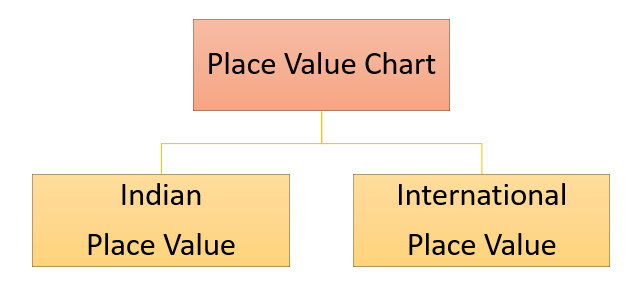
To make it easier to read, a number is separated into groups of digits using commas. Each of these groups is called a period. When a number is expressed in this form, it is called the “standard form” of the number. There are two number systems that are used worldwide. Indian Place Value system and International Place value system.
Source: Kapdec.com
- The major difference between two systems of breaking up numbers is the position of placing commas for grouping numbers into periods.
- Also, in Indian number system we use terms like ones, tens, hundreds, thousands, lakhs and crores whereas in International number system we use terms like ones, hundreds, thousands, millions and so on.