Kapdec Resources
Congruence In Lines And Angles
KAPDEC® | Elite STEM Learning Platform | https://kapdec.comUnit: Congruency Chapter: Congruence in Lines and Angles Reference: - Basic Angle Relationships, Parallel Lines and Tr...
KAPDEC® | Elite STEM Learning Platform | https://kapdec.com
Unit: Congruency
Chapter: Congruence in Lines and Angles
Reference: - Basic Angle Relationships, Parallel Lines and Transversals, Perpendicular Lines and Angle Congruence, Triangle Angle Properties, Angle Congruence Theorems & Proofs, Applications & Problem-Solving
After studying this chapter, you should be able to understand:
- Geometry: - Lines & Angles
- Basic Angle Relationships & Parallel Lines and Transversals
- Perpendicular Lines and Angle Congruence
- Triangle Angle Properties & Angle Congruence Theorems & Proofs
Geometry: Lines and Angles
Theorems:
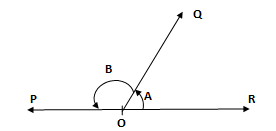
Axiom 1- If a ray stands on a line, then the sum of two adjacent angles so formed is 180°.
Source: Kapdec.com
As we can see that PR is a straight line, thus angle formed on a straight line is 180°.
Therefore, ∠A + ∠B = 180°, thus the sum of adjacent angles is equal to 180°.
Also, when the sum of two adjacent angles is 180°, then they are called a linear pair of angles.
Axiom 2- If the sum of two adjacent angles is 180°, then the non-common arms of the angles form a line.
- The two axioms above together are called the Linear Pair Axiom.
Theorems related to Lines and Angles
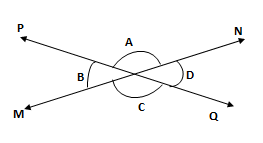
Theorem 1- If two lines intersect each other, then the vertically opposite angles are equal.
Source: Kapdec.com
Proof- ∠A & ∠C and ∠B & ∠D are vertically opposite angles.
As we can see, MN is a straight line and ∠A & ∠B are adjacent angles on it,
∠A + ∠B = 180° .... (a) (Axiom 1)
Similarly, PQ is also a straight line and ∠A & ∠D are adjacent angles on it, so
∠A + ∠D = 180° .... (b) (Axiom 1)
Equating (a) & (b), we can say that ∠B = ∠D.
Similarly, we can proof this theorem for ∠A & ∠C.
Transversal Line
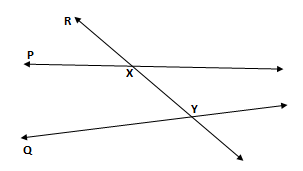
A line which intersects two or more lines at distinct points is called a transversal line.
Source: Kapdec.com
Line R intersects lines P and Q at points X and Y respectively. Therefore, line R is a transversal for lines P and Q.
Here, we can observe that four angles are formed at each of the points X and Y.
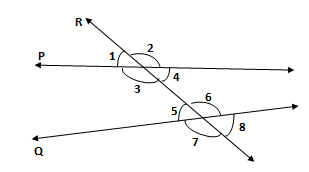
Let us name them, ∠1, ∠2, ∠3 ... ∠7 & ∠8.
Nomenclature of angles related to transversal line.
Source: Kapdec.com
- ∠ 1, ∠ 2, ∠ 7 and ∠ 8 are called exterior angles and ∠ 3, ∠ 4, ∠ 5 and ∠ 6 are called interior angles.
- Corresponding angles-
- ∠ 1 and ∠ 5
- ∠ 2 and ∠ 6
- ∠ 4 and ∠ 8
- ∠ 3 and ∠ 7
- Alternate interior angles-
- ∠ 4 and ∠ 5
- ∠ 3 and ∠ 6
- Alternate exterior angles-
- ∠ 1 and ∠ 8
- ∠ 2 and ∠ 7
- Consecutive interior angles-
- ∠ 4 and ∠ 6
- ∠ 3 and ∠ 5
Relationship between angles
Axiom 3- If a transversal line intersects two parallel lines, then each pair of corresponding angles is equal.
Therefore,
-
- ∠ 1 = ∠ 5
- ∠ 2 = ∠ 6
- ∠ 4 = ∠ 8
- ∠ 3 = ∠ 7
Also,
Axiom 4- If a transversal line intersects two lines such that a pair of corresponding angles is equal, then the two lines are parallel to each other.
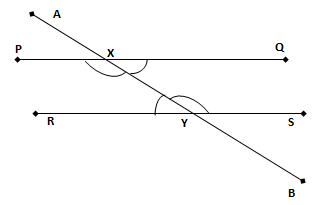
Theorem 2- If a transversal intersects two parallel lines, then each pair of alternate interior angles is equal.
Proof- As we know ∠QXY = ∠AXP....... (Vertically Opposite angles)
Also, ∠AXP = ∠XYR..... (Axiom 3, Corresponding angles)
Equating both, we can conclude that,
∠QXY = ∠XYR
Source: Kapdec.com
Similarly, we can prove this for,
∠PXY = ∠XYS
Converse, of Theorem 2 is also true.
Therefore,
Theorem 3- If a transversal intersects two lines such that a pair of alternate interior angles is equal, then the two lines is parallel.
Theorem 4- If a transversal intersects two parallel lines, then the consecutive interior angles are supplementary.
So, ∠QXY + ∠XYS = 180° and ∠PXY + ∠XYR = 180°
Converse, of Theorem 4 is also true, so,
Theorem 5- If a transversal intersects two lines such that a pair of interior angles on the same side of the transversal is supplementary, then the two lines is parallel.
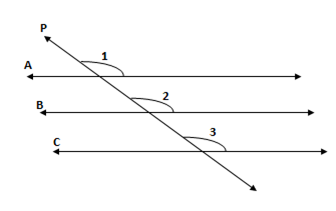
Lines Parallel to Same Lines
Source: Kapdec.com
Given, Line A∥

Source: Kapdec.com

Source: Kapdec.com
So as, A∥ B, ∠1= ∠2..... (Corresponding angles)
Also, A∥ C, ∠1= ∠3..... (Corresponding angles)
Thus, we can say that ∠2 = ∠3
Now as ∠2 = ∠3, we can say that line B ∥ C.
Theorem 6- Lines which are parallel to the same line are parallel to each other.
- Congruent Angles – Two angles are congruent if they have the same measure.
- Angle Addition Postulate – If a point lies inside an angle, the sum of the two smaller angles equals the measure of the larger angle.
- Complementary Angles – Two angles are complementary if the sum of their measures is 90°.
- Supplementary Angles – Two angles are supplementary if the sum of their measures is 180°.
- Vertical Angles – When two lines intersect, the opposite (vertical) angles formed are always congruent.
- Parallel Lines and Transversals – When a transversal intersects two parallel lines, special angle relationships are created, including corresponding, alternate interior, alternate exterior, and consecutive interior angles.
- Perpendicular Lines – Two lines are perpendicular if they intersect at a 90° angle.
- Perpendicular Bisector Theorem – A point on the perpendicular bisector of a segment is equidistant from the segment’s endpoints.
- Right Angles Congruence Theorem – All right angles are congruent, meaning they have the same measure of 90°.
- Triangle Sum Theorem – The sum of the interior angles of any triangle is always 180°.
- Exterior Angle Theorem – The measure of an exterior angle of a triangle is equal to the sum of the two non-adjacent interior angles.
- Congruent Supplements Theorem – If two angles are supplementary to the same angle, then they are congruent.
- Congruent Complements Theorem – If two angles are complementary to the same angle, then they are congruent.
- Geometric Proofs – A logical sequence of statements and reasons used to justify geometric relationships and congruence.