Discover the difference between Tutors vs Mentors and why students need more than subject help. Learn how mentorship creates confidence, structure, and long-term academic success.
Tutors vs Mentors: Why This Difference Matters
Tutors vs Mentors is one of the most important conversations in modern education. Many students believe they simply need someone to explain chapters, solve doubts, and help them prepare for exams.
But real academic success requires much more.
Students do not just struggle with subjects—they struggle with confidence, consistency, time management, and motivation.
This is where the difference between Tutors vs Mentors becomes powerful.
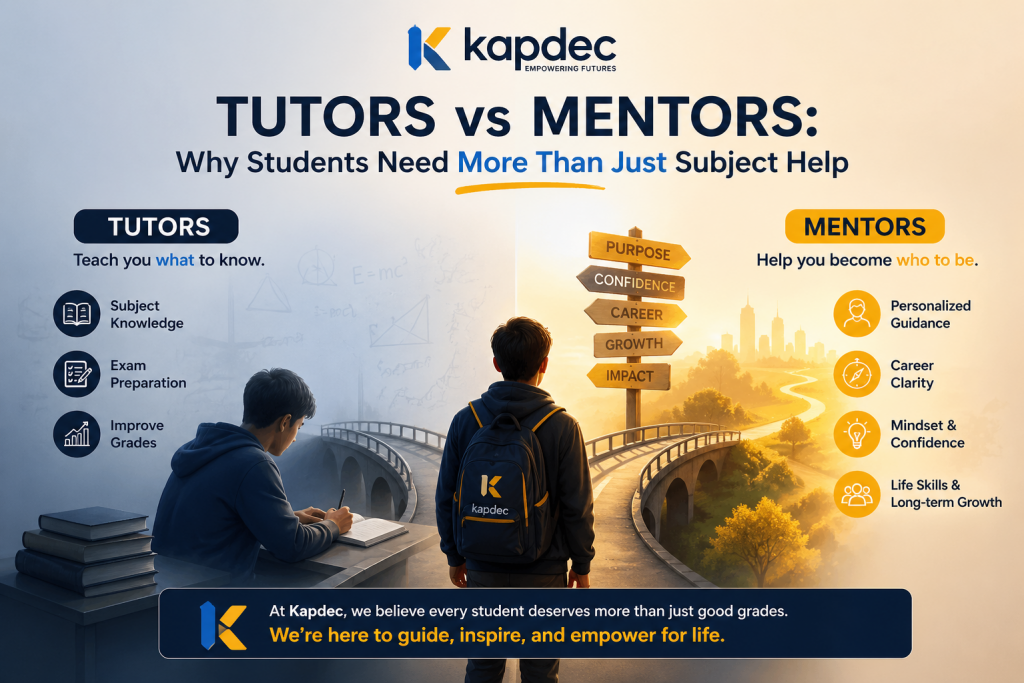
A tutor teaches content.
A mentor helps a student grow [1].
What Traditional Tutoring Usually Focuses On
Traditional tutoring often works in a simple way:
- explaining difficult topics
- solving homework problems
- preparing for tests
- revising the syllabus
This support is useful, but it is often limited to short-term academic help.
According to Kapdec students perform better when learning includes emotional support, accountability, and goal setting—not just academic instruction.
This is why the Tutors vs Mentors discussion matters.
Subject help alone is rarely enough.
What Mentorship Adds Beyond Tutoring
Mentorship focuses on the student, not just the subject.
A mentor helps students with:
- building confidence
- improving study habits
- managing time effectively
- setting academic goals
- overcoming fear of failure
- staying consistent over time
Platforms like Kapdec also emphasize mastery-based learning, where understanding matters more than memorization.
In the Tutors vs Mentors comparison, mentorship creates stronger long-term outcomes.
Why Students Need More Than Just Subject Help
Let’s take a simple example.
A student may understand math concepts during tutoring sessions but still perform poorly in exams because of:
- exam anxiety
- poor revision strategy
- lack of confidence
- inconsistent practice
A tutor may solve the problem for that day.
A mentor helps solve the system behind the problem.
This is the real difference in Tutors vs Mentors.
Students need guidance, not just answers.
Tutors vs Mentors in Outcome-Based Education
Modern education is shifting toward outcome-based learning.
Parents and students now ask:
“What result will this tutoring create?”
Not just:
“How many classes will be taken?”
You can also explore our internal guide on Outcome-Based Learning Plans to understand how structured mentorship improves measurable student success.
In the Tutors vs Mentors model, mentorship drives:
- stronger academic performance
- independent learning skills
- long-term confidence
- sustainable improvement
This creates real return on investment.
How Kapdec Builds Mentor-Led Premium Education
At Kapdec, the focus is not just tutoring—it is mentorship-driven education.
Kapdec believes students need:
- top-tier tutors with subject expertise
- structured guidance with measurable outcomes
- personalized support beyond academics
This is why Kapdec prioritizes:
- premium educators only
- outcome-based learning plans
- focused mentorship instead of random sessions
The goal is simple:
Not just better grades, but better students.
That is the true meaning of Tutors vs Mentors.
Why Mentorship Creates Better ROI for Parents
Parents often compare tutoring based on cost.
But the smarter question is:
What is the child truly gaining?
Mentorship-based tutoring helps students:
- improve faster
- build stronger fundamentals
- become more independent learners
- maintain long-term academic success
This makes premium education a stronger investment.
In the Tutors vs Mentors comparison, mentorship may cost more initially, but it delivers greater value over time.
FAQ’s
What is the main difference between Tutors vs Mentors?
The main difference in Tutors vs Mentors is that tutors focus on teaching subjects, while mentors focus on the overall growth of the student. A tutor helps with concepts, homework, and exam preparation, whereas a mentor also supports confidence, study habits, time management, and long-term academic development. Mentorship goes beyond subject knowledge and helps students become better learners.
Why do students need mentors and not just tutors?
Students often struggle with more than academic concepts. They may face low confidence, poor planning, exam stress, or lack of motivation. Tutors can solve subject-related doubts, but mentors help students handle these deeper challenges. In the Tutors vs Mentors discussion, mentorship creates stronger long-term improvement because it addresses both academic and personal growth.
Can a tutor also act as a mentor?
Yes, the best tutors often become mentors when they guide students beyond the syllabus. A tutor who helps with goal setting, motivation, and learning strategies adds much more value than someone who only explains lessons. This combination creates better results and stronger student trust.
Why does mentorship-based tutoring often produce better academic results?
Mentorship-based tutoring improves learning systems, not just test performance. Students learn how to manage time, revise effectively, and stay consistent. This leads to stronger understanding and independent problem-solving. In Tutors vs Mentors, mentorship builds habits that continue helping students even after tutoring ends.
Is mentorship-based tutoring worth higher fees?
Yes, because mentorship offers more than regular academic sessions. It includes personalized guidance, structured progress tracking, and emotional support, which often lead to faster and more sustainable results. While the price may be higher, the long-term return on investment is usually much better for both students and parents.
How can parents identify whether their child needs a tutor or a mentor?
If a child only needs help with specific chapters or test preparation, a tutor may be enough. But if the child struggles with confidence, consistency, focus, or overall academic direction, mentorship is more valuable. Parents should look at the root problem rather than just the subject difficulty when deciding between Tutors vs Mentors.
Final Thoughts
Tutors vs Mentors is not about choosing one over the other.
It is about understanding what students truly need.
Tutors help students understand subjects.
Mentors help students understand themselves.
The best academic outcomes happen when subject expertise is combined with confidence-building, accountability, and long-term guidance.
That is why students need more than just subject help.
They need someone who helps them grow, not just someone who helps them pass.
And that is the future of education.