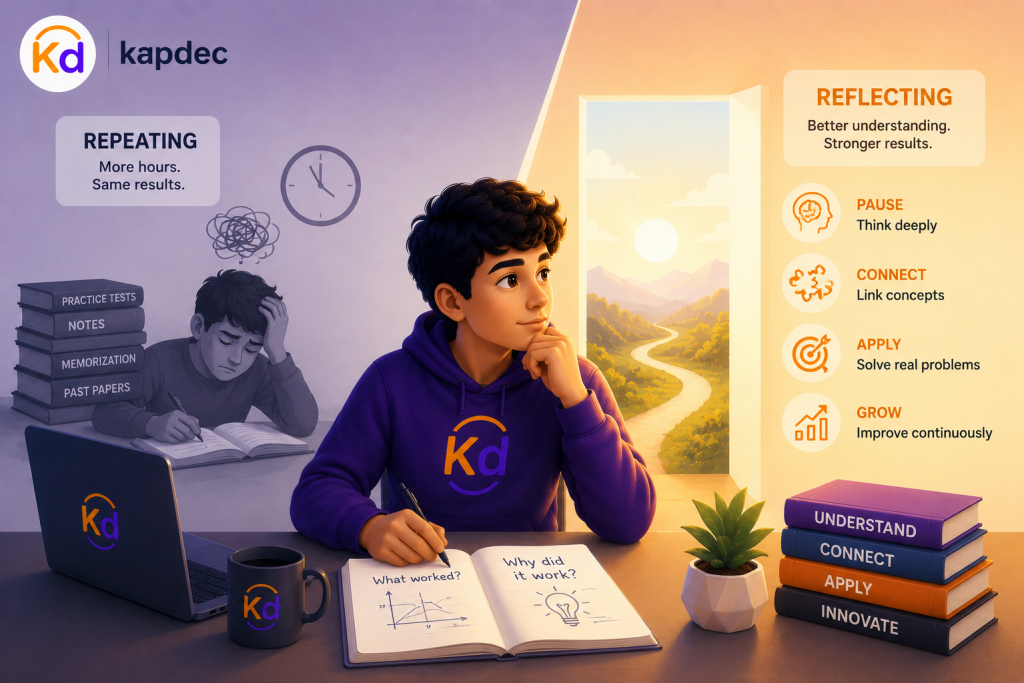
Discover why great STEM students spend more time reflecting than repeating. Learn how reflection, metacognition, error analysis, self-assessment, and mentorship accelerate long-term learning and academic success.
Why Great STEM Students Spend More Time Reflecting Than Repeating
Why Great STEM Students Spend More Time Reflecting Than Repeating is a lesson that separates high achievers from students who simply spend more hours studying. Many learners believe improvement comes from repeating the same exercises over and over. While practice is essential, repetition alone does not always produce mastery. Lasting growth happens when students pause to analyze what worked, identify what went wrong, and refine their learning strategies.
The most successful STEM students understand that learning is not just about doing more—it’s about thinking more deeply about what they have learned. Reflection transforms experience into understanding, helping students retain knowledge, strengthen problem-solving skills, and continuously improve.
Why Reflection Improves Long-Term Retention
A key reason behind Why Great STEM Students Spend More Time Reflecting Than Repeating is that reflection helps transfer information from short-term memory into long-term understanding.
After solving a problem or completing an assignment, effective learners ask questions such as:
- Why did this solution work?
- Which concept was most important?
- Could there have been a better approach?
- Where did I struggle?
Answering these questions reinforces learning far more effectively than immediately moving to another set of similar problems.
Reflection helps students build meaningful connections between ideas, making it easier to recall concepts in future situations.
Learning From Mistakes Instead of Simply Practicing More
Many students respond to poor results by increasing the number of practice questions they complete.
Elite learners take a different approach.
Instead of asking:
“How many more questions should I solve?”
They ask:
“Why did I make this mistake?”
Mistakes often reveal:
- conceptual misunderstandings
- calculation errors
- careless habits
- weak reasoning
- ineffective study methods
Understanding the root cause prevents students from repeating the same errors and leads to faster improvement [1].
Developing Metacognitive Skills
Metacognition is the ability to think about one’s own thinking.
It is one of the strongest predictors of academic success because it enables students to monitor and improve their learning process.
Students with strong metacognitive skills regularly:
- evaluate their understanding
- identify knowledge gaps
- choose effective study strategies
- adjust learning techniques
- reflect on their progress
Instead of studying on autopilot, they make intentional decisions about how to learn more effectively.
Using Journals, Error Logs, and Self-Assessment
Reflection becomes even more powerful when it is documented.
Many high-performing STEM students maintain:
Learning Journals
Students summarize key concepts, record insights, and note questions for future exploration.
Error Logs
Mistakes are categorized according to their causes, helping students identify recurring patterns and avoid repeating them.
Self-Assessments
Students periodically evaluate their strengths, weaknesses, and progress toward academic goals.
These simple tools create a structured process for continuous improvement rather than relying on memory alone.
How Reflection Accelerates Continuous Improvement
Reflection transforms every learning experience into an opportunity for growth.
A continuous improvement cycle often follows this pattern:
- Learn new concepts.
- Apply them through practice.
- Analyze results.
- Reflect on successes and mistakes.
- Adjust strategies.
- Apply improved methods.
Each cycle strengthens understanding while building confidence and intellectual independence.
Organizations such as the Kapdec have highlighted that reflective learning strengthens deeper understanding, self-regulation, and long-term academic performance.
The Role of Mentorship in Reflective Learning
Reflection becomes more meaningful when students receive thoughtful guidance.
Mentors help learners:
- interpret mistakes objectively
- ask deeper questions
- recognize hidden strengths
- identify better strategies
- build confidence through constructive feedback
Rather than focusing only on grades, mentors encourage students to understand how they learn, making reflection a consistent habit instead of an occasional activity.
How Kapdec Encourages Reflective STEM Learning
Kapdec believes that lasting academic excellence comes from thoughtful learning rather than endless repetition.
Its mentorship-driven approach encourages students to:
- review completed work carefully
- analyze problem-solving methods
- strengthen conceptual understanding
- develop metacognitive skills
- build independent learning habits
- embrace continuous improvement
Students learn to reflect on their progress, helping them become more efficient, confident, and adaptable learners.
You can also explore our internal guide on The Competitive Advantage of Students Who Learn How to Learn to discover how self-awareness and learning strategies support long-term STEM success.
Why Reflection Creates Future STEM Leaders
As STEM careers become increasingly complex, success depends on more than technical knowledge.
Future scientists, engineers, and innovators must evaluate their own thinking, adapt to new challenges, and improve continuously.
Reflection develops these abilities by encouraging students to think critically about both their successes and their mistakes.
Students who reflect regularly become better learners because they improve not only what they know but also how they learn.
FAQ’s
Why is reflection more effective than simply repeating practice questions?
Reflection helps students understand why they made mistakes and how they can improve, rather than just completing more questions. While repetition reinforces familiar concepts, reflection strengthens long-term understanding by encouraging students to analyze their thinking process, identify knowledge gaps, and apply better strategies in future learning. This leads to deeper mastery instead of short-term memorization.
What are metacognitive skills, and why are they important in STEM?
Metacognitive skills refer to a student’s ability to think about and evaluate their own learning process. These skills help learners recognize what they understand well, identify areas that need improvement, and choose effective study methods. In STEM subjects, where concepts often build upon one another, strong metacognitive abilities enable students to solve problems more efficiently and become independent, lifelong learners.
How can students learn more effectively from their mistakes?
Instead of viewing mistakes as failures, students should treat them as valuable learning opportunities. After completing an assignment or test, they can review incorrect answers, identify the root cause of each mistake, and determine how to avoid repeating it. Whether the error resulted from a misunderstanding, calculation mistake, or lack of preparation, analyzing it carefully leads to stronger understanding and continuous improvement.
How do learning journals and error logs improve academic performance?
Learning journals allow students to summarize important concepts, record insights, and reflect on their daily progress. Error logs help track recurring mistakes by documenting what went wrong and how similar errors can be prevented in the future. Together, these tools encourage self-awareness, improve retention, and create a structured approach to learning that helps students steadily strengthen their knowledge over time.
What role do mentors play in reflective learning?
Mentors help students reflect more effectively by asking thoughtful questions, providing constructive feedback, and guiding them through challenging concepts. Instead of simply correcting mistakes, mentors encourage students to analyze their reasoning, identify better problem-solving strategies, and build confidence through continuous improvement. This personalized guidance helps learners develop stronger critical thinking and more effective study habits.
How can students make reflection part of their daily study routine?
Students can dedicate five to ten minutes after each study session to review what they learned, identify areas of difficulty, and write down key takeaways. They can also maintain an error log, set weekly improvement goals, and regularly assess their progress. Making reflection a consistent habit transforms every study session into an opportunity for deeper learning, helping students improve more efficiently while building long-term academic confidence.
Final Thoughts
Why Great STEM Students Spend More Time Reflecting Than Repeating highlights one of the most effective yet often overlooked learning strategies.
Practice remains important, but meaningful progress comes from understanding mistakes, evaluating learning strategies, and continuously refining one’s approach.
With mentorship and reflective learning through Kapdec, students develop stronger critical thinking, better retention, greater confidence, and the lifelong ability to improve with every challenge they encounter.
The students who achieve lasting success are not necessarily those who practice the most—they are the ones who learn the most from every practice session.