Discover what Future Engineers and Doctors Do Differently in High School and how mentorship, analytical thinking, and intentional learning environments shape elite STEM success.
What Future Engineers and Doctors Do Differently in High School
What Future Engineers and Doctors Do Differently in High School often has very little to do with simply studying harder.
Many students assume future STEM leaders are simply “naturally smart.”
But in reality, high-performing students usually begin developing different habits, thinking systems, and learning strategies years before college admissions begin.
The biggest difference is not talent alone.
It is intentional preparation.
Future engineers and doctors quietly build analytical thinking, discipline, intellectual curiosity, and strategic learning habits long before most students fully understand their future goals.
Why Future STEM Leaders Start Preparing Early
Students aiming for careers in engineering, medicine, and advanced STEM fields often understand an important truth early:
Elite opportunities reward long-term development.
Strong STEM students rarely wait until senior year to become serious.
Instead, they gradually build:
- mathematical confidence
- scientific reasoning
- disciplined study systems
- problem-solving ability
- intellectual curiosity
This early momentum compounds over time.
According to Kapdec, students develop stronger long-term academic performance when they engage in curiosity-driven and analytical learning environments early.
This is why What Future Engineers and Doctors Do Differently in High School becomes such a powerful topic [1].
How Analytical Thinking Separates Top STEM Students
Future engineers and doctors do not simply memorize information.
They train themselves to think differently.
For example, strong STEM students often:
- ask deeper questions
- analyze patterns carefully
- challenge assumptions
- connect ideas across subjects
- focus on understanding systems instead of memorization
This creates higher-level problem-solving ability.
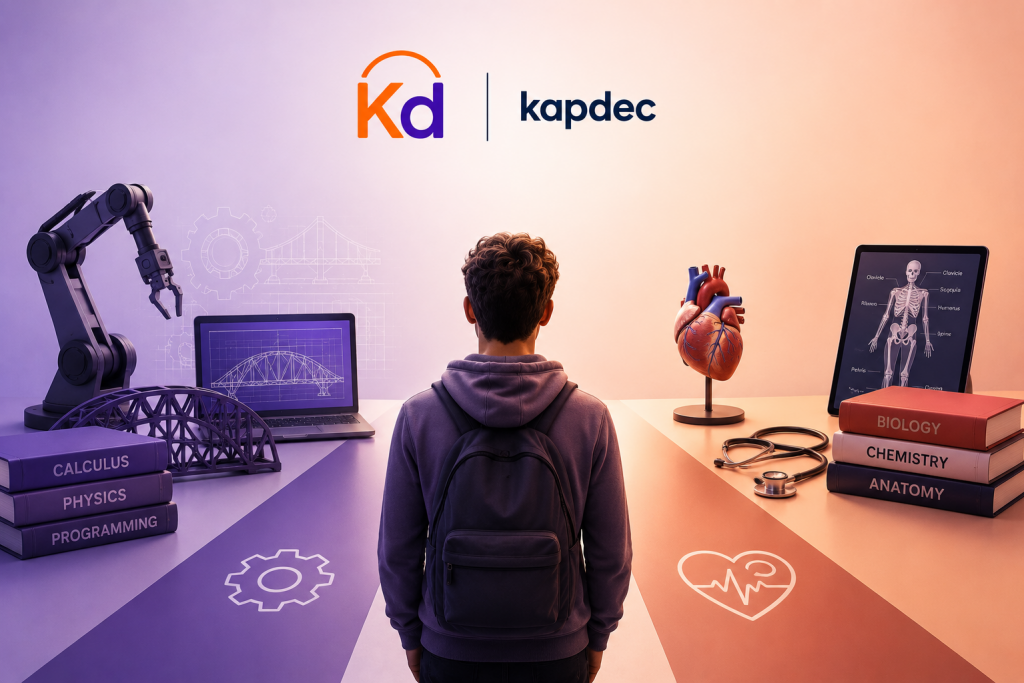
A future engineer may become fascinated by how systems operate.
A future doctor may develop strong observational thinking and scientific curiosity early.
Over time, these habits create massive intellectual advantages.
That is one reason What Future Engineers and Doctors Do Differently in High School is closely connected to mindset development.
Why Discipline Matters More Than Occasional Motivation
High-performing STEM students usually rely less on motivation and more on structure.
They often build consistent routines involving:
- focused study blocks
- structured revision
- long-term project work
- deliberate practice
- independent learning
This consistency becomes extremely valuable in demanding fields like engineering and medicine.
Students who develop disciplined systems early often transition more smoothly into advanced academic environments later.
You can also explore our internal guide on How Top STEM Students Learn Faster Without Burning Out to understand how structure and strategic learning improve long-term STEM performance [2].
How Mentorship Accelerates Future STEM Leaders
One major hidden advantage among future STEM leaders is mentorship.
Strong mentors help students:
- identify academic strengths early
- choose meaningful learning opportunities
- avoid inefficient study habits
- develop intellectual confidence
- think strategically about future goals
This guidance often creates years of advantage.
Platforms like Kapdec offer excellent STEM resources, but mentorship adds personalized acceleration and long-term direction.
Future engineers and doctors rarely grow through information alone.
They grow faster when guided by people who understand high-level learning pathways.
That is another important lesson behind What Future Engineers and Doctors Do Differently in High School.
Why Intentional Learning Environments Matter
Exceptional students are often shaped by exceptional environments.
High-level learning environments encourage:
- curiosity
- intellectual discussion
- analytical thinking
- accountability
- long-term growth
Students surrounded by ambitious peers and strong mentors often develop higher standards naturally.
Kapdec strongly aligns with this philosophy by promoting:
- premium mentorship
- practitioner-led STEM education
- outcome-based learning
- intellectually challenging environments
Rather than encouraging passive tutoring, Kapdec focuses on helping students build future-ready thinking habits early.
Why College Admissions Are Only the Beginning
Many students treat high school only as preparation for admissions.
Future STEM leaders think differently.
They understand that:
- engineering requires deep problem-solving ability
- medicine requires long-term discipline and resilience
- STEM careers reward adaptability and critical thinking
As a result, they focus on becoming capable—not just competitive.
This creates stronger long-term outcomes than simply chasing grades alone.
That is why What Future Engineers and Doctors Do Differently in High School extends far beyond applications and resumes.
FAQ’s
1. What do future engineers and doctors typically do differently in high school?
Future engineers and doctors often focus on building strong analytical thinking, discipline, and problem-solving habits early. Instead of studying only for exams, they develop deeper understanding in subjects like mathematics and science, explore intellectual curiosity, and create consistent learning systems that prepare them for long-term STEM success.
2. Why is early mentorship important for future STEM leaders?
Mentorship provides students with strategic guidance that helps them learn more efficiently and avoid common academic mistakes. Strong mentors help students identify strengths, strengthen weak areas, and develop long-term thinking habits. This support often accelerates growth years before college applications even begin.
3. How do high-performing STEM students approach learning differently?
Top STEM students focus heavily on understanding concepts rather than memorizing information. They ask deeper questions, analyze patterns, and practice solving unfamiliar problems. This approach builds adaptability and confidence, which are essential in demanding fields like engineering and medicine.
4. Why are intentional learning environments so valuable?
Students often perform better when surrounded by ambitious peers, strong mentors, and intellectually challenging environments. Intentional learning environments encourage accountability, curiosity, and deeper thinking. Over time, these surroundings help students naturally develop higher academic standards and stronger learning habits.
5. Do future engineers and doctors focus only on grades in high school?
No, high-performing STEM students usually focus on developing long-term capabilities alongside good grades. They often build skills like critical thinking, research ability, discipline, and independent learning because they understand that STEM careers require much more than exam performance alone.
6. Can average students become future STEM leaders with the right guidance?
Yes, many successful STEM students are developed through consistent effort, mentorship, and strong learning systems rather than natural talent alone. Students who build disciplined habits, strong fundamentals, and analytical thinking early can significantly improve their academic and career trajectory over time.
Final Thoughts
What Future Engineers and Doctors Do Differently in High School ultimately comes down to intentional growth.
Exceptional STEM students often begin building:
- analytical thinking
- disciplined learning habits
- intellectual curiosity
- strategic mentorship relationships
- strong academic foundations
years before admissions season begins.
The students who eventually stand out are rarely the ones relying only on last-minute effort.
They are usually the students who quietly developed stronger systems, deeper thinking habits, and better guidance much earlier.
Because future STEM leaders are not created overnight.
They are built gradually through consistent preparation and intentional learning over time.